
How to Help Children Cope with Change: Moving, Divorce, & Grief
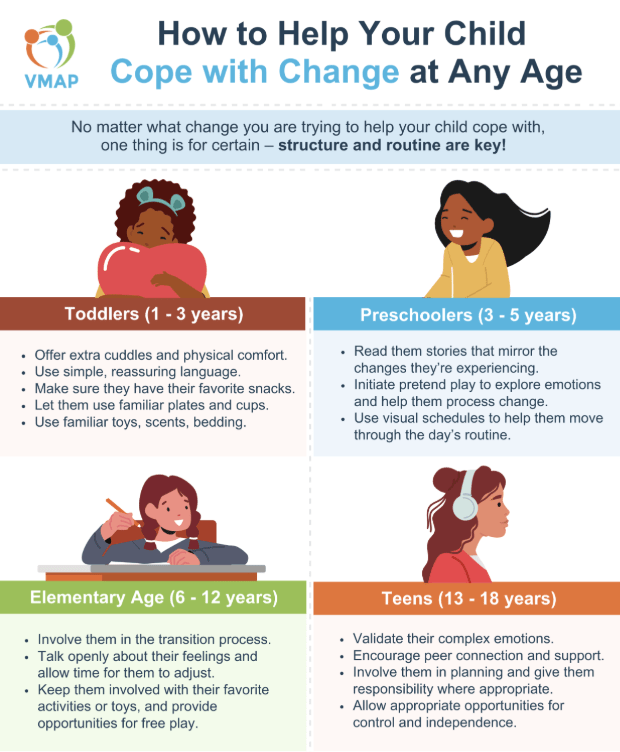
Don’t leave without downloading this resource handout, which covers how to help children cope with change at any age!
Download Now
Big events like a move, divorce, or loss of a loved one are life-changing, and children are especially sensitive to these disruptions. In this article, we’re going to explore how each of these common situations impacts children’s mental health, describe warning signs that your child is having trouble adjusting to change, and how you can support your child to make the process easier.
Moving
The place your child calls home is a pivotal element of their development. The neighborhood, schools, community, and friends they make along the way have long-term effects on their well-being. When you decide to move, your child will leave all this behind, impacting their sense of security and belonging, which can negatively affect their mental health in turn.
Your child's age at the time of your move is critical, with researchers finding that moves occurring between ages 11 – 18 are far more detrimental than ones before the age of 10. It predicts poorer mental health, which persists even into their college years. More frequent moves is also a factor, with researchers finding that three or more moves is twice as detrimental as one or two.
Moving is often inevitable, and it can be because of positive circumstances – a new job, moving closer to family, a better house, neighborhood, or school district. Just because it may impact your child negatively doesn't mean the risks outweigh the benefits, especially if you mindfully support them through the transition!
Divorce
With 50% of American children experiencing their parents' divorce, this subject has been the focus of many research studies over the years. It is generally agreed that children in divorced families fare worse emotionally, behaviorally, mentally, academically, and socially than their peers, and are more likely to experience adverse health outcomes like childhood obesity and asthma. All of these impacts are triggered by distress following major changes to a family's structure and functioning.
However, many children in divorced families exhibit resilience, and do not have obvious problems following this shift in their family dynamic. This can be attributed to a variety of factors that mediate the effects of divorce, such as less effective parenting, parental conflict, financial hardship, and limited contact with one parent. It's also important to note that staying together is not always a healthy option, just to avoid the potential impact of that experience on your child. Living in a home with high conflict or abuse also enhances the risk of a child developing mental and behavioral health issues.
Your child's age at the time of your move is critical, with researchers finding that moves occurring between ages 11 – 18 are far more detrimental than ones before the age of 10. It predicts poorer mental health, which persists even into their college years. More frequent moves is also a factor, with researchers finding that three or more moves is twice as detrimental as one or two.
Moving is often inevitable, and it can be because of positive circumstances – a new job, moving closer to family, a better house, neighborhood, or school district. Just because it may impact your child negatively doesn't mean the risks outweigh the benefits, especially if you mindfully support them through the transition!
Grief
Around 1 in 13 children (6 million) will experience the death of a parent or sibling by age 18, and nearly 2 million will lose both their parents. This kind of loss is widely considered to be the most difficult of adverse childhood experiences. Childhood is a critical time for all kinds of development, and parents serve as a buffer against stress and a source of support. Children who lose a parent are twice as likely to have poorer functioning at home and at school, even seven years later. Those whose parents died before they were 12 had higher rates of depression than those who lost a parent in adolescence.
Helping Children Cope with Change
No matter what change you are trying to help your child cope with one thing is for certain – maintaining structure and routine is key! We have a handout you can download on the left, which details how to help your child cope with change at any age.
In this section, we’re going to cover tips for building and sticking to routines, how to maintain them during change, and guidance on supporting your child through moving, divorce, and grief.
1. How to Create Structure & Routine for Your Family
We have a whole other blog post on routines for kids, which you can use as an in-depth resource. There are several opportunities for routines that happen almost every day. If you don't already have a plan in place for them, it's worth it to make one!
- Mornings: Think about what it takes to get your child out of bed and out the door, then design a routine where one action flows into the next.
- Mealtimes: Meal planning and meal prepping are great ways to reduce the stress of figuring out what everyone is going to eat.
- After School: When your child gets done with a long day at school, a routine can help ease their transition from tired and overwhelmed to cool and calm.
- Homework: The last thing any kid wants after a long day at school is to do their homework, but it has to be done!
- Evenings: Just like afternoons, evening routines can look different depending on what you have planned.
- Bedtime: The routine leading up to bedtime should help your child get physically and mentally ready to fall asleep.
Routines can be hard to stick to, especially if you and your child are not used to having them. Here are some tips on keeping routines consistent day-to-day:
- Keep routines where everyone can see. The fridge or your child's bedroom door are two great places to stick routine checklists. You can print off a new sheet every week for your child to check off each day, or you can laminate the printout so you can erase it.
- Focus on making routines for the busy times, not for down time. Creating a flow for getting ready for school or bed is great, but it's important to let your children have an unstructured space to decompress when there's time to spare.
- Build family traditions and rituals. These are another kind of routine that can help children make sense of holidays, birthdays, and other events. Some ideas include family movie night, making holiday cookies, or always going out for dinner when it's someone's birthday. Little things like this are great ways to build connection consistency for your child.
- Stick to routines as much as possible but stay flexible! Instead of worrying about the exact time or sequence that your routine happens in, focus on keeping the rhythm of things similar. For example, if you get home late from an activity, still read with your child as planned – but maybe one book or chapter less than usual.
2. How to Maintain Structure & Routine During Change
This section is adapted from a fantastic article by D.D. Fritch at HeartsConnected, called “A Guide to Helping Children Cope With Big Changes in Their Small Lives”. We’ve adapted this into the downloadable handout above.
| Toddlers (1 – 3 years) | Preschoolers (3 – 5 years) |
|---|---|
|
|
Elementary Age (6 – 12 years) |
Teens (13 – 18 years) |
|
|
3. How to Help Your Child Cope with Common Big Changes
We've already discussed the impact of big changes like moving, divorce, and grief on children – here are some specific ways you can support your child during these transitions.
Helping Your Child Cope with Moving
- Create a "memory book" with photos of important people from home.
- Schedule regular or recurring video calls with close friends and family.
- Validate your child's feelings about loss; don't minimize or problem-solve.
- Involve your child in registering for activities before the move (sports, arts, clubs).
- Arrange a school tour and let your child meet their teachers before their first day.
- Be honest with your child about why you're moving and highlight the positives.
- Let your child get involved with designing or furnishing their new room.
- If your child is a senior in high school, it may be worth considering letting them stay with a trusted friend or family member in their hometown until they graduate.
Helping Your Child Cope with Divorce
- Set expectations of co-parenting and custody from the beginning. Here is some advice from HelpGuide on managing these complicated situations!
- Tell the truth, but simply. Agree in advance on an explanation for your separation and stick to it.
- For younger children, remind them that even though parents can sometimes get divorced, parents and kids don't stop loving each other or get divorced.
- Consistently tell your child that you love them, as a reminder that your love has not gone anywhere.
- Keep routines and structure consistent between parents. This can be hard to do, but it's incredibly important!
- Communicate directly with the other parent; don't expect your child to be a messenger.
- Let your child talk to the other parent whenever they need to; it's not a competition.
Helping Your Child Cope with Grief
- Use simple, direct, and developmentally appropriate language to tell your child that someone they loved has died. Here is a guide on how to navigate this conversation!
- Be honest about your own grief and sadness, so your child can use this as a model for expressing their own feelings and know it's okay to be sad and to cry.
- Listen to your child, don't just talk at them. It can be easy to get carried away and try to over-explain but make sure you prioritize making space for your child's voice.
- Accept help from your friends, family, and community, so your child can see support from others in their life.
Warning Signs that Your Child is Struggling with Change
Every child will cope with big life events differently, but here are some clear signs that they’re having trouble adjusting and may need more support.
| Mental Health Warning Signs in Children Under 12 | Mental Health Warning Signs in Children Over 12 |
|---|---|
|
|
When you speak with your child's pediatrician about the things you've noticed, you want to give them all the information they need. To do this, try to keep track of these three things when you observe a warning sign:
- Intensity: How severe are the symptoms your child is experiencing?
- Duration: How long are the symptoms lasting?
- Distress Level: How distressing are the symptoms to your child?
Framing your observations with these in mind will help their pediatrician better understand the situation so they can make an informed recommendation. If your child needs additional support, check out our guide on how to seek mental health care for your child!
This was a lot to go through, but so is change – especially for your child! If you have additional questions about helping your child transition with change or are noticing warning signs that they’re not adjusting well, your child’s pediatrician is a great resource.